Note: A few years ago I wrote both about the famous Korean chawan kown by its Japanese name the Kizaemon Ido and about the The Joseon (Choson) Potter’s Studio and Kiln.
This is an attempt to clarify my personal thoughts about their connection after reading those written by Soetsu Yanagi. Some of this post is a restatement of the earlier post on the Joseon potter’s studio and kiln.
Most often when we look at chawan our entire attention is on the bowl. Perhaps that is how it should be. Particularly in today's tea world when the prestige of the potter may cloud our ability to perceive the work. That has never been the problem with the old Korean chawan known by its Japanese name the Kizaemon Ido. Whether or not we appreciate the Kizaemon Ido, we are not encumbered with knowing the name of the potter who produced it. That particular potter remains unknown and we will never know who specifically made it. However some have attempted to identify with that potter because to do so somehow could bring us closer to the bowl itself.
How can one begin to channel the spirit of those Korean potters who produced the bowls that became cultural treasure chawan in Japan? What was their state of mind and the conditions of their life and environment that contributed to such a bowl?
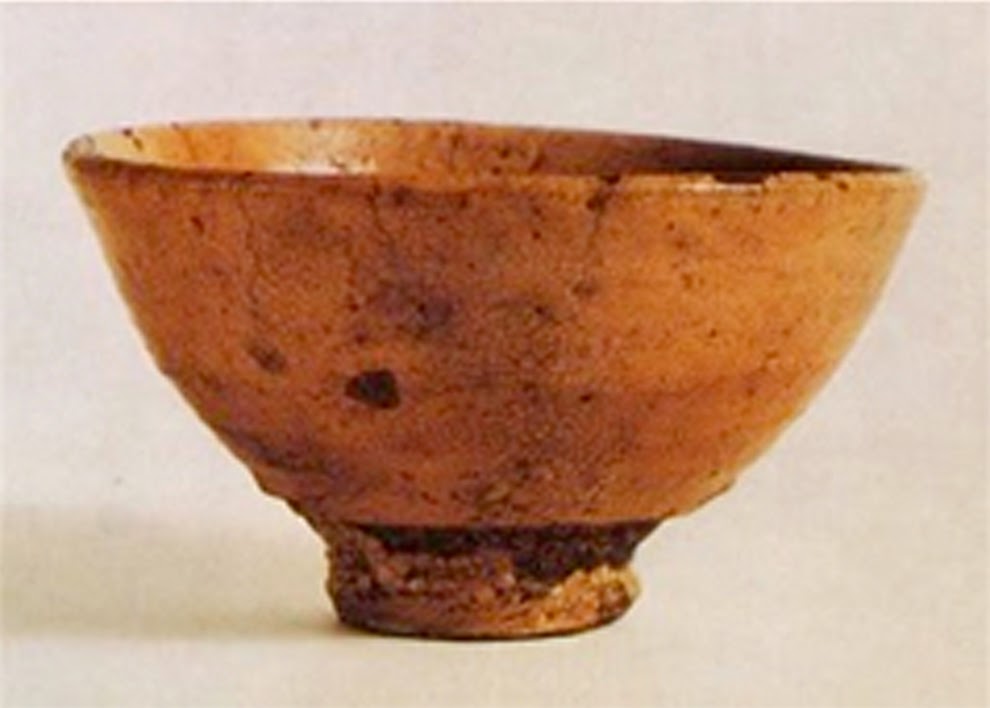

The Kizaemon Ido
The great Japanese aesthetician Soetsu Yanagi, author of the book The Unknown Craftsman, while speaking of the creation of the Korean bowl known as the Kizaemon Ido wrote:
The clay had been dig from the hill at the back of the house; the glaze was made with the ash from the hearth; the potter’s wheel had been irregular. The shape revealed no particular thought: it was one of many. The work had been fast; the turning was rough, done with dirty hands; throwing slipshod; the glaze had run over the foot. The throwing room has been dark. The thrower could not read. The kiln was a wretched affair; the firing careless. Sand had stuck to the pot, but nobody minded, no one invested the thing with any dreams. [1]
Speaking of the potter who created the Kizaemon Ido, Yanagi wrote:
In Korea such work was left to the lowest. What they made was broken in kitchens, almost an expendable item. The people who did this were clumsy Yokels, the rice they ate was not white, their dishes were not washed. If you travel you can find these conditions anywhere in the Korean countryside. This and no more, was the truth about this, the most celebrated Tea-bowl in the land. [1]
Yanagi later writes of the potter:
It is impossible to believe that those Korean workmen possessed intellectual consciousness. It was precisely because they were not intellectuals that they were able to produce this natural beauty. The bowls were not products of conscious effort by the individual. The beauty in them springs from grace. Ido bowls were born not made. Their beauty is a gift an act of grace. [1]
Continuing a little later he writes:
It is nature that makes laws work. To observe them is appreciation. Neither is a matter of the maker’s intellectual ingenuity. The artistic qualities inherent in a Tea Bowl belong to nature in their origins and to intuition in their perception. [1]
But was Yanagi
correct in his assessment? I have so much respect for this man Yanagi
and his philosophy it is difficult to argue with him. I do know if we really want to begin to understand what went into the creation of the Korean rice bowl, that became Japan’s most precious and respected tea bowl we have to look at the potter and the conditions that helped to create it. Thus this particular post.
In some ways, this particular post has been on a long journey. Many years ago Yanagi’s close friend Bernard Leach in private conversation discussed the writings of Yanagi when I visited the Leach studio as a young student of pottery. At that time I asked if anything by Yanagi were translated into English. Leach replied that he was working on a translation and that it should be finished in two or three years. I waited 15 years until the Unknown Craftsman was finally published. I was not disappointed.
I will attempt to discuss this issue from my personal point of view, a view formed after living in Korea for a year, mostly working in a Korean potter’s studio, and researching this and related topics on more than thirty visits to Korea since. As an aside, you may want to know that I also worked for a short time with the famous Japanese potter Hamada Shoji another of Yanagi’s good friends.
I will attempt to discuss this issue from my personal point of view, a view formed after living in Korea for a year, mostly working in a Korean potter’s studio, and researching this and related topics on more than thirty visits to Korea since. As an aside, you may want to know that I also worked for a short time with the famous Japanese potter Hamada Shoji another of Yanagi’s good friends.
On the issue of what person and conditions formed the Kizaemon Ido, there may not be a “right” or a “wrong”. opinion. Yanagi viewed the conditions that created this bowl from a Japanese point of view (not withholding his great interest in Western aesthetics and art - even Christian mysticism). Of course his point of view was not shared by all in his country, he was a creative and insightful writer but neither he nor any of us can really escape our environment. In fact that concept is the basis of his thoughts as well as mine on the potter who formed the Kizaemon Ido chawan. He wrote his thoughts at a time not long after his country had fought two major wars, one with China and the other with Russia, the one with China on Korean soil. That war was fought so Japan could eventually annex Korea. The Japanese assassinated the Queen of Korea who sided with China and later, after essentially occupying Korea for 15 years, during which the war with Russia was fought, forced Korea into annexation. I don’t believe that Yanagi agreed with his government on either war or the annexation of Korea and certainly not the assassination of the queen. Which of us individuals can control the decisions of our government? He worked to save and preserve the arts of Korea.
However, as a result of the annexation, Yanagi could visit Korea often with his friends Bernard Leach and Hamada Shoji. What did they see in Korea? In the early 1900's, they saw a depressed Korea. They saw a people and society in depression. Was Korea in depression in the late 1500's when the Kizaemon Ido bowl was made?
It is difficult to know exactly when the Kizaemon Ido was created, who created it or even where it was created in Korea. Was it made before the Imjin War (1592-1598)? That was a war that truly devastated the entire country of Korea. Was it made during the time of that war? Was it made after the war? Some suggest that the famous Japanese teamaster Sen Riku saw and used this bowl. It certainly lives up to Sen Riku’s philosophy of aesthetics. Some say it was a ‘captive’ bowl presumably spoils of the Imjin War. It cannot be both. Sen Rikyu opposed the war and most likely for this and various other reasons Hideoshi commanded Sen Rikyu to commit seppuku. That took place a year before the Imjin War.
When speaking of the potter who created the bowl Yanagi often refers to the absence of “intellectual consciousness”. Presumably a potter with “intellectual consciousness” would ‘understand’ each step of the process and deliberately create such a bowl. Yanagi writes:
The bowls were not products of conscious effort by the individual. The beauty in them springs from grace. [1]
Soetsu Yanagi goes on to say:
Ido bowls were born not made. Their beauty is a gift an act of grace. [1]
I love the concept that the best chawan are ‘born not made’. In my own work I often find chawan that are ‘better than I can do’ and therefore in a sense ‘born’ not from my conscious intent but from ‘grace’. But they would not have existed without me.
Again, of the potter and the conditions, Yanagi wrote:
Again, of the potter and the conditions, Yanagi wrote:
The work had been fast; the turning was rough, done with dirty hands; throwing slipshod; the glaze had run over the foot. The throwing room has been dark. The thrower could not read. [1]It is interesting that Yanagi included the sentence, "The thrower could not read." The ability to read is not an indication of intelligence but more of life's circumstance. I believe there are several types of ‘intelligence’. I call them ‘ways of being’: the emotional, physical, perceptual, intellectual and spiritual ways of being or 'intelligences'. I believe these Korean potters were more than ‘intellectual’ they were in tune with nature. They were part of nature. If not 'intellectuals' or 'academically educated', these potters certainly were physically, emotional, perceptually and spiritually astute. They knew their clay, wheel (wobbly as it may have been), ash laden feldspathic glaze and kiln intimately. These were part of their natural way of being with ‘clay’, of being a potter. Poor people yes, common “clumsy Yokels” no. The Ido bowls were no accident. They may not have come from deliberate intellectual intention and they may have been in a sense ‘born not made’ as the outer forces of clay, wheel, glaze kiln and fire did their part, but without the physical perceptual, emotional and yes spiritual intent of these skilled potters these bowls would not have existed. Most Ido bowls are of a similar size and form. So much so that some scholars today are suggesting the form came from a specific order or series of orders placed by Japanese tea masters. They were not pure accident. Full of grace yes, accidental no. The basic form was deliberate whatever the motivation that conceived that form.
What then was in place in Korea consciously or unconsciously to create this form? As suggested earlier these potters were essentially a part of nature - in tune with nature. One of my teachers Hamada Shoji always stressed that we must go beyond the technical into nature. [2] These Old Korean potters were already there. They 'knew the technical' perhaps without knowing they 'knew it'. In a very real sense, they were part of nature.
Nature and the natural are ingrained into the culture and people of Korea. The old Korean aesthetic principals are centered around nature around the Korean aesthetic concept of Pungnyu in Korean. Jon Carter Covell and her son Alan in their book, The World of Korean Ceramics, wrote of Pungnyu:
Korean fifteenth-sixteenth century folk ceramics connote an aesthetic principle termed Pungnyu in Korean, meaning literally "Wind Flow." This suggests movement in a psychological sense — movement unrestrained by social; tradition, for who can control the wind either its direction or velocity? Wind may be a gentle zephyr or a typhoon.“Flow” links man with nature; he flows from birth to death, and perhaps the two are a continuum. In “Wind Flow” there exists the sense of an informal motion which equals Time, a continually changing “eternity,” which manifests itself in different shapes. The teabowl now in the hand had been at an earlier moment of time merely raw earth; then for a short period, a blazing firebrand, and now it rests calmly in the palm. Presently the ceramic bowl can be enjoyed by both the eyes and fingers as a metamorphosed miracle, a frozen instant in the flow of time itself. [3]
It is very interesting that the grandfather of the great tea master Sen Riku’s was a Korean aesthete working in Japan. Scholars suggest that much of Sen Rikyu’s philosophy of nature came from his grandfather.[3] The philosophy of Pungnyu is imbued in the work of those Korean potters - deliberate, calculated, intellectualized most likely not but Pungnyu was there in abundance none-the-less. It was simply their way of being with clay - with nature.
There are basically two conditions that influence the creation of any work of art: they are: 1. The “inner” conditions including the skills, eye, hand and creative spirit of the potter and 2. The “outer” conditions that lie beyond the potter. These include: not only the clay, wheel, tools, kiln and firing conditions but also the process of preparing the clay, the studio as well as the environment and atmosphere under which the potter works.
The potter brings to his work a working attitude. In addition to an innate imbued “understanding” of Pungnyu, the old Korean potter had “han” a universal Korean spirit making him close to nature. He was most likely “jang-in” a master and/or he was “janggi” a free spirit. He just made the work. (In those days most likely the one forming the work was “he” a man. [4] He wasn’t encumbered by any attempt to be creative – just make the work -- as many of the same pieces as one can make in a morning. Today there are Korean tea ware potters who can form on a wheel 400 tea bowls in the morning and trim them in the afternoon. So certainly a similar number was possible 600 years ago. But even if they only made 200 pieces, a lot of work was produced and not much time was spent on any of them. I recently watched the Korean Cultural Asset Kim Jong Ok form the last 30 or 40 of 400 teacups he made in an afternoon. [5]
Having worked with the very disciplined Japanese potter Inoue Manji, I have some sense of what is needed to produce a lot of the same pieces one after another in a short period of time. But I am sure the Korean potter in the 1500's did not approach his work in the same manner as the highly disciplined Arita porcelain Intangible Treasure Inoue. The old Korean potter was relaxed, unassuming and approached his work with little or no thought. But not without purpose. The form was not an accident even though it most likely sprung easily from just three ‘draws’ on the wheel. Perhaps the ease and directness of those three draws helped create the form of the bowl. Those of us who have ever been “production potters” know that when you get “into the grove” of production work, your mind empties and your "body knowledge" simply takes over. If we don’t care if they are 'precise' 'perfect' matches to one another the work produced is relaxed and natural. This process sounds very easy – just do it – but the reality of it is much different. We contemporary potters or "ceramic artists" have so many things that influence us that it is difficult if not impossible to adopt a “no mind”, or in Korean a “mot shim” approach. But that is probably where the old Korean potter's mind was when these ido bowls were created. A “mot shim” or no mind approach does not imply a lack of purpose but rather 'body purpose' not 'mind purpose'. Hamada once told us, “It is nearly impossible to create loose work in a tight society.” [2] We in the West have that problem. Hamada said that Japan suffers from the same problem – potters in a tight society attempting to create loose work. I once watched a Japanese cultural treasure famous for his chawan (not Hamada or Inoue) form a tea bowl. I was stunned that he went over that bowl many times before it was formed to his satisfaction. That was not the way of these Korean potters of the 1500's.
For the Korean Joseon dynasty potter, making the “loose” bowl was natural, a result of the life and conditions under which he worked.
This, I believe were the factors and conditions that led to the state of mind of the old 16th century Korean potter that formed the Kizaemon Ido. The bowl was full of grace but grace from the outer conditions not the inner ones, just as the bowls we produce today may be also full of grace but not accidental grace.
I am tempted here to reflect on the role of the Japanese tea master in the "creation" of this bowl but that topic must be reserved for another day.
I have addressed above what I believe to be their state of mind. What were the conditions of their life and environment that contributed to such a bowl? It has been difficult to know precisely when and where these bowls were made - before, during or after the Imjin War. Each different time would have impacted the potter, so without that information I have difficulty going beyond what I have already written. Then, what was the environment in which he worked?
To address this we have only to look carefully at this studio perhaps Korea’s only remaining Joseon Dynasty studio and kiln. It speaks beyond words to the life and work produced there. In this case the space for the studio has been dug out of a hillside.

This provided additional insulation for the studio. The walls of the studio where the Kizaemon was made were most likely very similar. Potters, perhaps with the help of some friends, often made their homes and studios of raw clay, possibly some stones and trees they cut from the hills. It probably had a rice straw thatched roof. Their kilns were also made of raw clay. Creating a home and studio was hard work but most likely the materials were free and properly cared for it would last a life time and more as this studio has done.
I am tempted here to reflect on the role of the Japanese tea master in the "creation" of this bowl but that topic must be reserved for another day.
I have addressed above what I believe to be their state of mind. What were the conditions of their life and environment that contributed to such a bowl? It has been difficult to know precisely when and where these bowls were made - before, during or after the Imjin War. Each different time would have impacted the potter, so without that information I have difficulty going beyond what I have already written. Then, what was the environment in which he worked?
To address this we have only to look carefully at this studio perhaps Korea’s only remaining Joseon Dynasty studio and kiln. It speaks beyond words to the life and work produced there. In this case the space for the studio has been dug out of a hillside.
This provided additional insulation for the studio. The walls of the studio where the Kizaemon was made were most likely very similar. Potters, perhaps with the help of some friends, often made their homes and studios of raw clay, possibly some stones and trees they cut from the hills. It probably had a rice straw thatched roof. Their kilns were also made of raw clay. Creating a home and studio was hard work but most likely the materials were free and properly cared for it would last a life time and more as this studio has done.
The preparation of the clay to make the ware was a lengthy process involving digging the clay, drying it and crushing it.
That was followed by soaking it into a slurry and screening that slurry, then ladling that clay slip onto the drying field through another screen.

Once the clay had stiffened it was cut into large chunks and brought into the studio.

In the studio it was foot kneaded and hand kneaded before ready for forming. (A more comprehensive description can be found here.) Between 5 and 8 kilograms would be centered from which 10-12 sabbal (bowls) would be formed, each with a sufficiently large thick foot.
There was a window next to the wheel providing light during the forming process. The wheel was a simple kick wheel with very little "carry" or centrifugal force. It might wobble slightly, a condition the potter thought nothing of. The Korean potter established a rhythm and relationship with their wheel. In a sense wheel and body became one. A wobbly pot stops wobbling when the wheel stops - so it doesn't matter.
There was a window next to the wheel providing light during the forming process. The wheel was a simple kick wheel with very little "carry" or centrifugal force. It might wobble slightly, a condition the potter thought nothing of. The Korean potter established a rhythm and relationship with their wheel. In a sense wheel and body became one. A wobbly pot stops wobbling when the wheel stops - so it doesn't matter.

Behind the potter or nearby there was a raised ondol floor under which charcoal or wood was burned. This was where the freshly formed work was placed for quicker drying so that they could be ready for trimming in the afternoon. The large thick foot would remain leather hard for trimming even with the use of the ondol-heated floor while the body of the bowl became a little stiffer.
Then there was the kiln.

This old studio and its kiln could have been made at least 600 years ago and may be quite similar to the studio used by the potter who made the Kizaemon Ido tea bowl.
The chambered kiln, commonly used in many parts of Korea for this type of work is called an orum gama or mangdaengi gama " 망댕이 가마" – the latter from the name of the hand formed raw clay columns or “bricks” used to form the dome of the kiln. This particular kiln is the oldest still functioning kiln remaining in Korea.(10) The kiln is quite large having six chambers. Each chamber also had its own “fire box”. The kiln was/is fired beginning with the primary firebox and working up the hill firing each of the chambers one after the other. There wee no shelves. In the case of bowls, small wads of clay were placed between the foot and the inside of the bowl. This way the bowls could be stacked as many as five bowls high. In separating the bowls after the firing some of the bowls would be ruined. It was not uncommon for the potter to lose 50% or more of the work produced.
All of this hard work and great loss of the work surely affected the potter. It was hard but honest work. Although potters were not rich and were of a “lower class” I believe they lived with a sense of accomplishment and dignity. We still have in Korea potter families who come from many generations of potters. Without at least a sense of dignity, pride and accomplishment these families of potters would not have continued.
All of this hard work and great loss of the work surely affected the potter. It was hard but honest work. Although potters were not rich and were of a “lower class” I believe they lived with a sense of accomplishment and dignity. We still have in Korea potter families who come from many generations of potters. Without at least a sense of dignity, pride and accomplishment these families of potters would not have continued.
To fully understand this Joseon potter, we do have to pause and consider the Joseon potter’s life style. We all have a sense of what life was like in our own countries 400 years ago. It certainly was no better in rural Korea. One can personally identify with what that life style would have been like. I believe the following quote from Hamada Shoji begins to explain the impact of the outer and inner conditions on the work of the Joseon Potter:
I think there are hardly any pots in the world through which a people’s life breathes more directly as Korean ones, especially Yi dynasty wares. Between pots and life, Japanese ones have “taste”, Toft wares have “enjoyment”, even the Sung pots have “beauty”, and so on. But the Yi Dynasty pots have nothing in between; peoples’ lives are directly behind the pots.[9]
Why is the Kizaemon Ido so natural? The early Korean potter lived a life close to nature and his work reflected nature’s connection.
Your comments are welcome.
Click here to go to the next post.
Your comments are welcome.
Click here to go to the next post.
Footnotes:
[1] Soetsu Yanagi, The Unknown Craftsman Kodansha International
[2] Personal notes taken during my studies under Hamada Shoji.
[3] Jon Carter Covell and Alan Covell The World of Korean Ceramics Si-sa-yong-o-sa, Inc.
[4] During the Chosun or Yi dynasty, women and children also worked in the pottery preparing clay and decorating. Today there are many well-established women ceramic artists in Korea and in modern Korea it was Ewah Woman’s University that first offered a class in ceramics.
[5] Witnessed during Tea Tour Korea 2014 a tour we hosted Spring 2014.
[6] If the clay did not support such treatment, as trimming, the bottom would be beaten to compress it and if a foot were needed it would be wheel formed. This was a rare practice but potters adapted naturally to the type of clay they had. I may look at their tools in a later post.
[7] Interestingly, during Hyeonjong's reign, after more than thirteen years in Korea, the Dutchman Hendrick Hamel left Korea and returned to the Netherlands, where he wrote a book about the Joseon Dynasty and his experience in Korea. This book introduced the small kingdom to many Europeans. A memorial to Hendrick Hamel can be found in Gangjin Korea.
[8] Today these slip processes are part of what is now known as the bungcheon decorating processes. The Kizaemon Ido is of the tum-bung-mun type or dipped slip type. A brushed slip type is called ‘gqey yl’.
[9] Bernard Leach, Hamada Potter, Kodansha International.
The term “Yi Dynasty” was often used by the Japanese in reference to the Choson or Joseon dynasty. The Yi family ruled Korea throughout the length of the dynasty. Yi is sometimes also Anglicized as Lee, Rhee or Ri. Hamada was not referring to the “greatness” of the work in this statement but to the connection between a people and their work. However, it is evident from his many comments about Korean ceramics that it was greatly admired. It is well known that Korean work influenced Hamada Shoji's work. In the first World Ceramic Exposition held in Icheon, South Korea in 2001 a special display showing the influence of Korean ceramics on the work of Hamada Shoji was featured. That exposition is held in three cities including also Yeoju and Kwangju. In April 2015, they will hold their 8th Exposition. Go to Korean Ceramic Tours to learn how you can join a tour when this or the next Exposition is held.
[10] This studio is
the family studio of the Kim family and is the only historically
preserved Joseon Dynasty family studios in Korea.
To join us for tea and tea ware at their festival. Go to www.TeaTourKorea.blogspot.com. Can't come, please tell your friends.